KLEP V2.0 for Unity
A downloadable Unity package for Windows
KLEP V2.0 for Unity
A deterministic, inspectable symbolic behavior toolkit for Unity 6 and headless .NET.
This page is the tested Unity developer distribution. The engine-independent C# source, architectural contracts, runnable example, and portable regression suites live at Roll4d4/klepV2.0 on GitHub. The exact public source snapshot is preserved in the 2.0.0-preview.4 release.
KLEP makes perceived facts, eligibility, scoring, lifecycle, output, and the reason one behavior won available as inspectable evidence. It overlaps with blackboards, behavior trees, utility AI, GOAP, state machines, and rule engines. Its case is a particular execution contract around familiar ideas: immutable snapshots, staged Key operations, deterministic Tandem waves, eligibility before influence, stable arbitration, explicit cleanup, and forensic traces.
2.0.0-preview.4: structural Goals and bounded Imagination
Preview 4 adds two deliberately separate proofs:
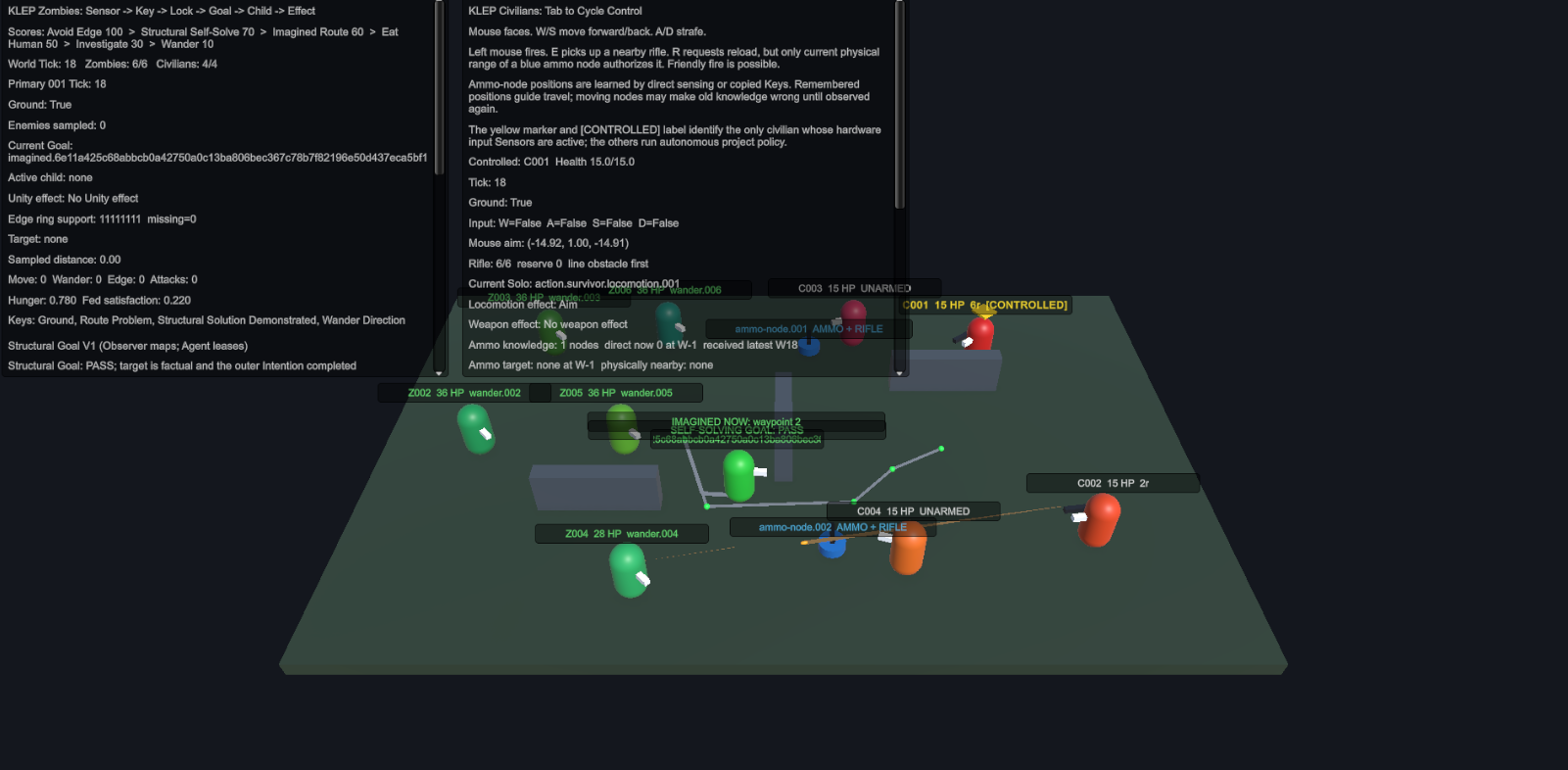
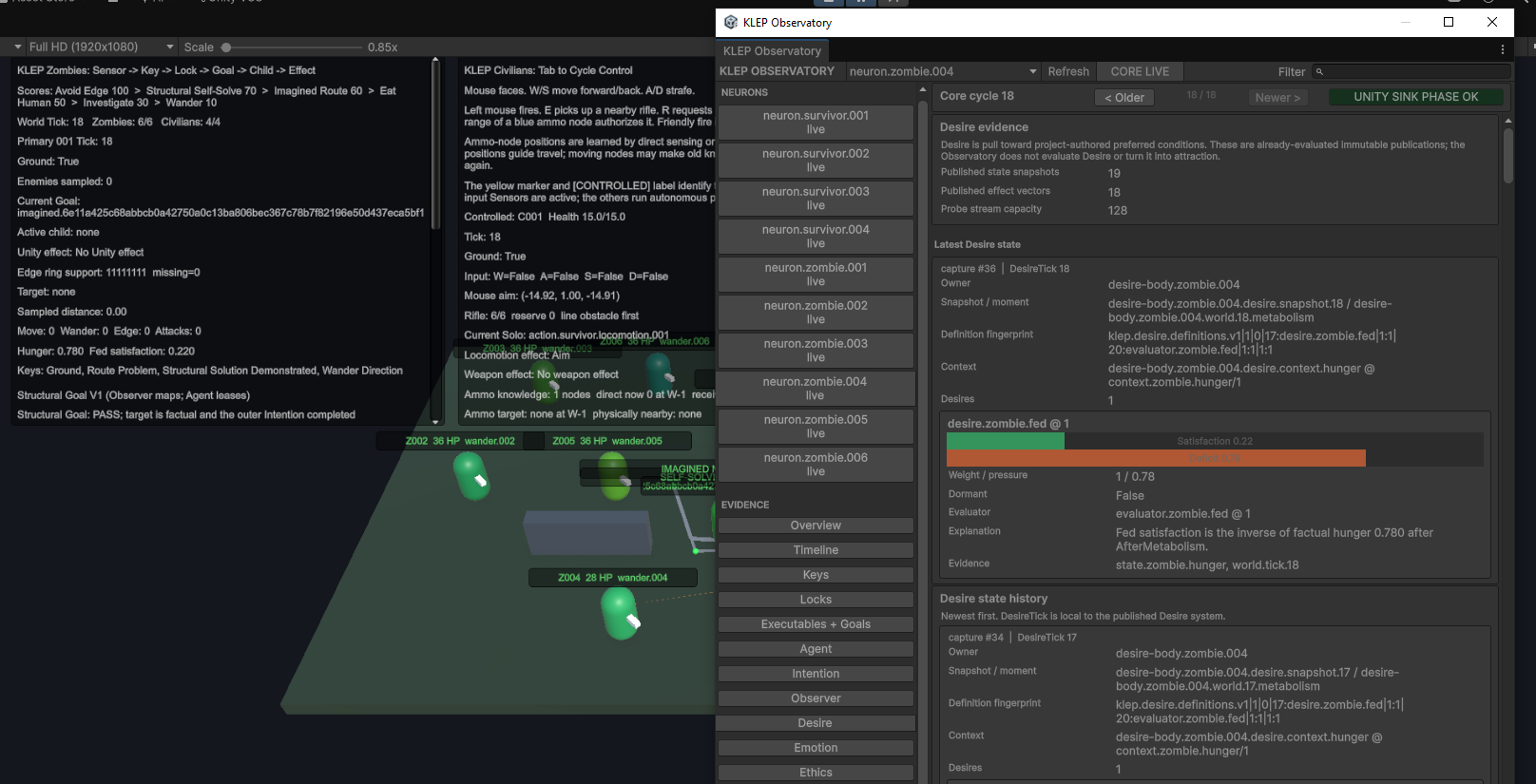
- Structural Goal proof. Zombie 001 owns an otherwise empty Goal with an explicit target Key. The Observer maps that target to one existing Action. The Agent selects only the outer Goal, leases the mapped Action, and completes the Goal and its Intention only after the Action's persistent output becomes factual at the next boundary. This is a diagnostic one-step proof over known capabilities.
- Cover/Route proof. The demo compiles one checked-in, hand-authored Strong Manifest, materializes four fresh disposable sandbox Agents, evaluates four deterministic wall trials, records an explicit accept/reject verdict, and creates a separate fresh live trial. This is bounded proposal admission, not a learned route.
No language model is connected in this release. Preview 4 does not claim general planning, autonomous code generation, model-generated behavior, or general machine imagination. Its Imagination layer is a strict contract for what a future proposal source may and may not submit. Weak Conjectures remain non-runnable.
The expanded Humans-versus-Zombies field
- Four civilians, six zombies, a 28 x 18 arena, and three physical cover walls.
- Two rifles begin on persistent, movable ammunition nodes. Nobody begins knowing where the nodes are.
- Civilians can observe or copy timestamped AmmoNodeSighting Keys; zombies exchange HumanSighting Keys. Freshness comes from the copied
observedWorldTickpayload, never delivery clocks. - Rifles carry six rounds and begin with no reserve ammunition. Zombies have 36 health, requiring eighteen clean two-damage hits: three full magazines.
- Autonomous civilians can seek remembered equipment and ammunition, avoid nearby zombies, clear friendly lines of fire, fire, and reload. Manual fire can produce factual friendly-fire Ethics evidence.
- Bright projectile trails replay already-resolved shot paths for inspection; they do not apply damage.
The working language
- Keys are immutable perceived fact occurrences.
- Locks are pure conditions over one frozen Key snapshot.
- Executables sense, route, or act through an explicit lifecycle.
- Goals are scored composite Executables. An explicitly targeted empty Goal may cache one Observer-built structural solution, but it does not search during execution.
- Neurons hold factual Keys and the Executable catalog.
- Agents own eligibility, scoring, deterministic selection, runtime, and the decision clock.
- Observers map the catalog and answer bounded structural questions, but cannot open a Lock, select behavior, or perform an effect.
Evidence boundary
The public engine-independent repository currently runs 25 project-authored suites with 4,988 assertion executions. The full Unity workspace runs 27 runnable suites with 5,088 assertion executions, plus 3 compile-only gates; all 30 gates passed. Repeated scenario checks count as assertion executions; these are not thousands of independent tests or third-party validation.
The exact preview.4 tarball was installed and compiled in a clean Unity 6000.5.4f1 project. A freshly built Windows archive was extracted and launched independently; its player log showed the Observer mapping the structural Goal, the Agent leasing and completing the Action, and the Goal and Intention completing at the following boundary.
There is not yet a connected model, general planner, automated graphical Play Mode behavior suite, comparative benchmark, production-adoption claim, or stable-API promise. Read the exact claims and evidence boundary and when to use KLEP before adopting it.
Tested with Unity 6000.5.4f1. Minimum declared editor: Unity 6000.0.
KLEP V2.0 is open source under the MIT License. The rewrite is human-directed and AI-assisted; provenance and current review limits are public. GitHub is the code-and-contract surface; itch.io is the Unity developer surface.
Download
Click download now to get access to the following files:
Development log
- Preview 4: A Goal Solves Its Own Shape, Carefully21 days ago
- Klepdate Desire is not an Emotion23 days ago
- KLEP Preview 0.1.1: The Agent Decides, the Observer Maps24 days ago
- Kelp is live24 days ago
- KLEP, the AI i invented.25 days ago